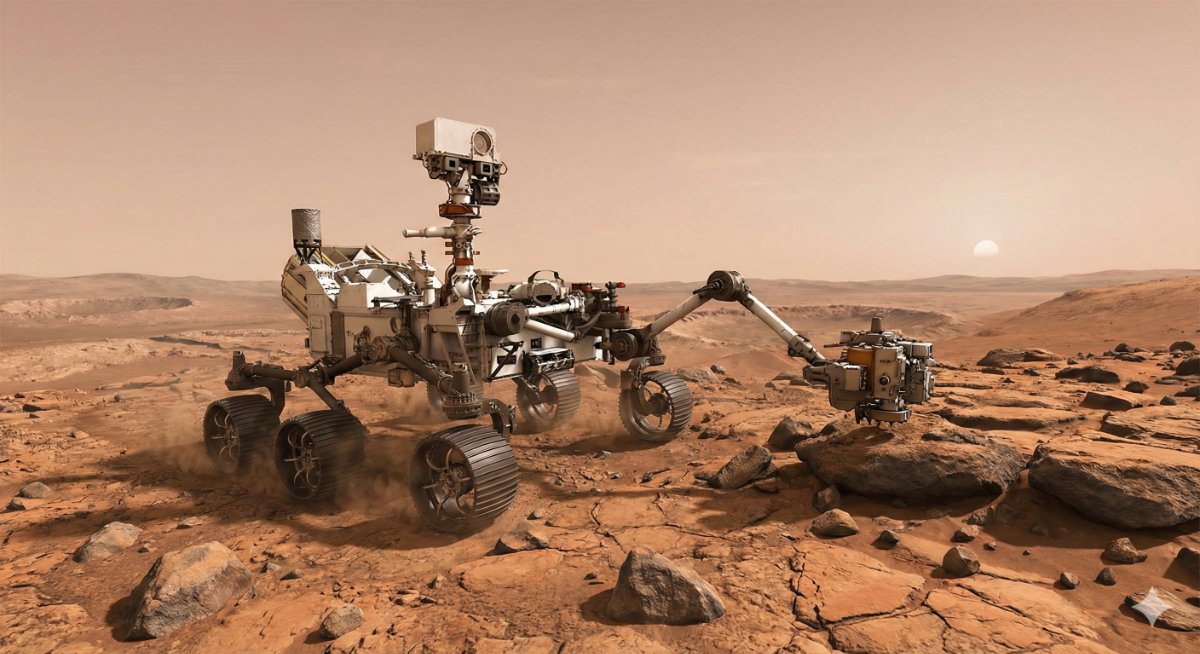


: From Chatbots to ‘Digital Workers’ — The Birth of a New Era On the barren, dusty surface of Mars, a robot worth a trillion won rolls its wheels in silence, cut off from communication with Earth. The control console at the ground station is silent. 250 million kilometers away, what’s sent to Mars isn’t human hands. It’s thousands of lines of code transmitted from Earth by **Claude**, an AI model developed by Anthropic.
Recently, NASA’s Jet Propulsion Laboratory (JPL) announced that they used Claude to plan the route of the Perseverance rover on Mars, successfully executing the actual drive. This achievement goes beyond a mere scientific milestone; it signals a massive **’Industrial Pivot’** that Silicon Valley boards and Wall Street investors should watch closely. We’ve long considered generative AI as poetic poets or coding assistants. But now, AI that has traveled to Mars has evolved into an **’Operating System for the Physical World’**. And this technology is returning to Earth, targeting legacy industries across the board.
1. The Challenges of Mars Exploration and Claude’s Innovation
The biggest obstacles in Mars exploration are ‘physical distance’ and ‘time’. Claude has overcome these absolute limitations with AI technology.
20 Minutes of Silence: The Limits of Human Control
Even at the speed of light, it takes 20 minutes for signals to reach Mars, and another 20 minutes for responses to return. The total lag of 40 minutes is fatal. If the rover faces a cliff and Earth yells “Stop!”, it’s already fallen 20 minutes earlier.
Due to this harsh physical limit, Mars exploration has relied on painstaking manual analysis by NASA experts. They zoom in satellite images pixel by pixel, plotting paths to avoid dunes and sharp rocks. This meticulous process meant that the maximum distance a state-of-the-art rover could travel in a day was only a few dozen meters. Humanity’s curiosity was bound by the speed of light.
Transforming Vision into Code: Agent Technology
By December 2025, humanity introduced a new variable into this tedious exploration equation: **’Agent AI’**. NASA JPL fed high-resolution images from Mars Reconnaissance Orbiter (MRO) into Anthropic’s Claude.
What’s astonishing is that Claude didn’t just “interpret” the images. It visually understood the terrain’s contours and hazards, then converted this understanding into **’Rover Markup Language’**, a specialized command language the rover can understand.
This isn’t just an abstract command like “Go north”. It generates precise, executable code that includes wheel rotation counts, steering angles, and obstacle avoidance protocols. As a result, the rover autonomously drove 456 meters along the planned route, reducing planning time by 50%. Human engineers could then focus on more critical scientific analysis instead of repetitive tasks.
2. The Operating System of the Physical World: Industry-Wide Scalability
The core insight is that **’Vision’ directly translates into ‘Action’**. The technology that moved the Mars rover can be directly copied and applied to Earth’s business environments. This is the essence of ‘Scalability’.
Ultra-Automation in Manufacturing & Logistics
Algorithms that navigate Mars’ rugged terrain mirror those used in complex logistics centers on Earth. Claude can analyze port container loading statuses or CCTV footage in real-time, determining “which zones are congested” and instantly relaying commands to forklifts or autonomous guided vehicles (AGVs).
Unlike traditional factory automation, which follows rigid programmed routines, Claude responds to unpredictable situations. It can detect subtle cracks in defective products on the production line, then generate real-time adjustments—such as fine-tuning robot arm angles by 0.1 degrees or slowing conveyor belts.
Particularly, Anthropic’s recent release of **’Computer Use’** feature maximizes physical scalability. Even legacy factory equipment without APIs can be controlled visually—AI recognizes screens and controls mouse cursors—turning old factories into smart factories without costly upgrades. This opens the door to intelligent factories without massive capital expenditure.
Risk Management in Finance & Legal: FinTech & Legal
Scalability isn’t limited to physical machinery. If we see a company’s business environment as a terrain, then complex financial regulations or legal contracts are like hidden rocks in a treacherous landscape. Claude can identify **’Risk Factors’** within these documents and chart safe paths. It goes beyond summarizing or flagging risky clauses; it can generate legally binding revisions and submit approval requests through internal systems like ERP, effectively executing the process.
3. The Twilight of SaaS and the Dawn of AI Agents
These technological advances threaten the very existence of traditional software industries, especially **SaaS (Software as a Service)** companies. The subscription-based SaaS model, once a symbol of the digital economy, is now fundamentally shaken.
Collapse of Per-Seat Pricing
Over the past decade, the ‘per-seat pricing’ model has been the golden rule of the IT industry. Companies grew by hiring more staff and purchasing additional accounts for Slack, Zoom, Salesforce, and others. This was the formula for SaaS growth.
But in the era of AI agents, this formula no longer holds. If a high-performance agent like Claude can analyze data and generate reports equivalent to ten new hires, companies won’t need to buy ten software accounts. Instead, they will hire (subscribe to) a single **’AI Agent’** that handles all tasks. This fundamentally disrupts the unit economics of software companies.
Selling Outcomes, Not Tools
The recent stagnation or decline of giants like Adobe and Salesforce stems from the fact that we’re moving away from a world where humans click through GUIs. Instead, Claude-like agents don’t click menus or buttons. They connect directly to back-end systems via APIs or control screens visually, executing tasks hundreds of times faster than humans. Software is shifting from a ‘visual tool for humans’ to an ‘invisible infrastructure operated by AI’. Now, the market prefers companies that sell **’outcomes’**—such as successful marketing campaigns or optimized supply chains—rather than just tools.
4. Why Did NASA Choose Anthropic?
Many AI companies claim their models are the best, but NASA’s choice of Anthropic as a partner for the extreme environment of Mars offers key insights for corporate leadership. They weren’t after the most creative or entertaining model.
Safety and Constitutional AI
The Perseverance rover is a marvel of human engineering, worth about 3 trillion won. A single mistake could lead to irreversible failure. NASA needed an AI without hallucinations and with predictable, controllable behavior. Anthropic’s **’Constitutional AI’** embeds principles and safety guidelines from the start, minimizing unpredictable actions. This aligns perfectly with the risk management needs of enterprise (B2B) markets.
Infrastructure Compatibility and Pragmatism
Practical reasons also played a role. NASA already uses AWS (Amazon Web Services) for data storage and analysis. Anthropic, as a key partner, could run seamlessly and securely on existing AWS infrastructure (like Amazon Bedrock). This shows that when adopting AI, ease of integration with legacy systems and infrastructure is often more critical than raw performance.
5. Conclusion: The Birth of a New Digital Workforce
Mars exploration is just the beginning. Claude has now shed its spacesuit, returned to Earth in a business suit, ready to oversee your company’s logistics, write code, and prepare factory lines for shutdown or startup.
If digital transformation (DX) so far was about converting paper to Excel, the future of **’AI Transformation (AX)’** will be about delegating human judgment and execution to machines. This is not mere automation; it’s autonomy.
The key question for business leaders now isn’t “Can AI write poetry?” but rather, **”Which physical and logical tasks will we delegate to AI?”** The remarkable scalability proven on Mars will soon shake the entire business ecosystem on Earth. AI is no longer just a helpful tool. It’s becoming your most capable and tireless **’Digital Worker’**—able to see data, judge, and act in the physical world to produce results.